Amalfi Coast Towns: All 13 Villages
Thirteen towns share the coastline between Vietri sul Mare and Positano, and most visitors see three of them. The other ten include the smallest municipality in Italy, a village built around a sea cave, a wine valley with no coastline at all, and a fishing port still making a sauce the Romans would recognise. Here is what each one is, who it suits, and how long it is worth.
Choose the towns for their differences, then match the transport. A three-town tour covers its listed stops; the quieter eastern and inland villages often deserve an independent day. Choose Your Experience Below.
The Amalfi Coast is not a single town with suburbs. It is thirteen separate municipalities strung along one road, each with its own council, its own patron saint and, in several cases, its own grudges going back to the medieval duchy. At the last official count they held 36,665 residents between them, roughly the population of a mid-sized market town, spread across cliffs, ravines and lemon terraces. Photographs flatten all of that into one view. The list below unflattens it.
Thirteen villages, just under 37,000 residents between them
Resident counts are the official municipal figures for every comune at the same reference date, 31 May 2026, so the thirteen are directly comparable. Eleven have a coastline. Scala and Tramonti are landlocked, and Ravello, though its territory touches the water at the hamlet of Castiglione, sits 350 metres up with no beach or harbour at the town.
Positano, Amalfi and Ravello make a first-visit trio. Keep Atrani as a nearby walk, group the eastern towns separately and do not expect a single outing to cover all thirteen. Explore the Positano, Amalfi and Ravello day tour from SorrentoExplore the Positano, Amalfi and Ravello day tour from Sorrento.
The Quick Answer
Positano, Amalfi and Ravello are the three most visitors see, and they earn it: a vertical fishing village, a former maritime republic, and a garden town 350 metres above the water. Praiano, Atrani and Minori are the pick of the quieter ten. Furore, Scala and Tramonti are for people who want somewhere the coaches never stop.
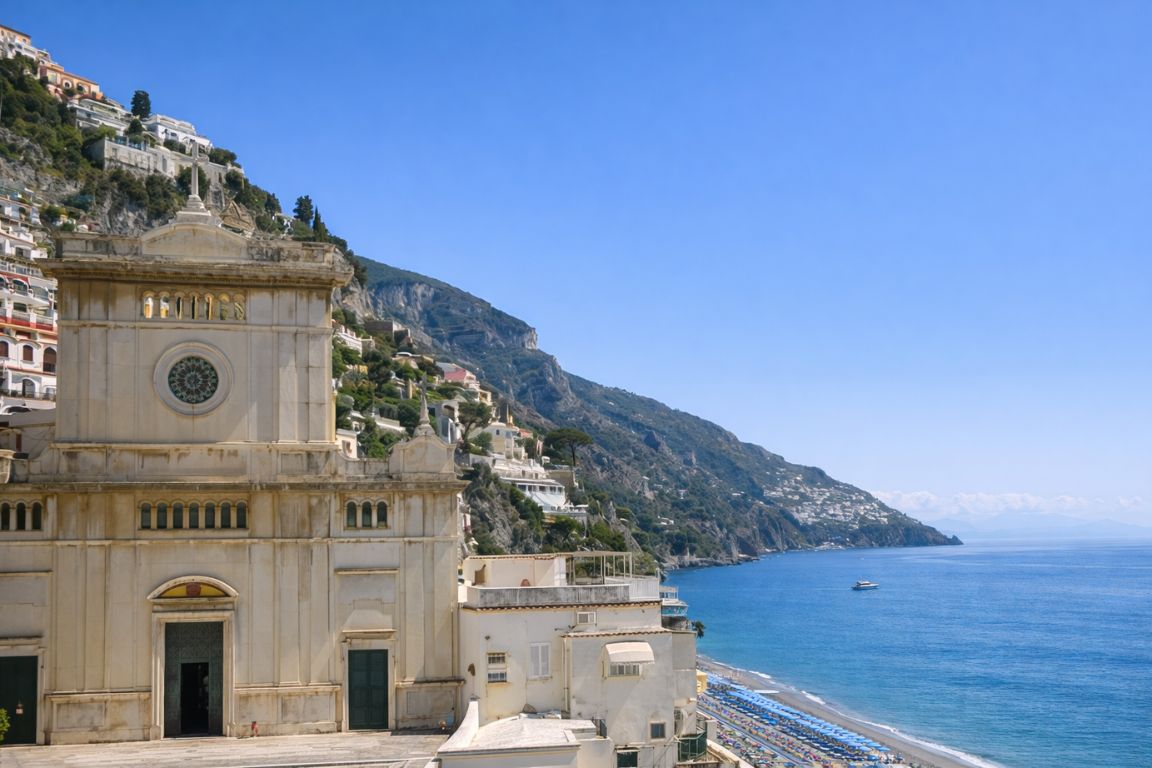
Which Towns Actually Count As The Amalfi Coast?
Thirteen comuni make up the Amalfi Coast: Positano, Praiano, Furore, Conca dei Marini, Amalfi, Atrani, Ravello, Scala, Minori, Maiori, Tramonti, Cetara and Vietri sul Mare. All sit in the Province of Salerno. The coast was inscribed as a UNESCO World Heritage Site in 1997 under the name Costiera Amalfitana, covering 11,231 hectares. That is the definition worth holding on to, because tourism marketing stretches the label freely.
One technicality is worth knowing. Thirteen towns make up the coast in every geographic and everyday sense, but the association that manages the World Heritage site lists fifteen comuni: the thirteen plus Corbara and Sant'Egidio del Monte Albino, two inland municipalities over the Lattari ridge that no visitor would ever describe as coastal. When a guide says thirteen and a heritage document says fifteen, both are right about different things.
The bigger confusion is easier to explain. Sorrento, Capri and Salerno are all sold as part of an Amalfi Coast trip, and practically speaking they belong on the itinerary. None of them is one of the thirteen. Sorrento sits on the opposite side of the Sorrentine Peninsula facing the Bay of Naples. Capri is an island. Salerno is a working port city of well over a hundred thousand people. The scenic run people mean when they say the Amalfi Drive is roughly 40 kilometres of the Strada Statale 163 between Positano and Vietri sul Mare, though the road itself is longer: ANAS puts the full SS163 at 50.4 kilometres from Meta on the Sorrento peninsula through to Vietri. It was built for Ferdinand II of Bourbon, begun in 1832, finished in 1850 and inaugurated in 1853, and it is still the only land route into the coast.
Eleven of the thirteen have a coastline. Two do not: Scala sits on the ridge above Amalfi, and Tramonti lies inland in a valley of vineyards and chestnut woods, connected to the sea only by the road down the Valico di Chiunzi to Maiori. Ravello is the awkward third case. Its territory does reach the water at the hamlets of Castiglione and Marmorata, a couple of hundred steps below the coast road, but the town itself is 350 metres up with no beach and no harbour of its own. That reshapes a lot of trip planning, because three of the coast's most interesting places have no beach you can walk to.
| Village | Residents | Setting | Best known for |
|---|---|---|---|
| Positano | 3,647 | Cliff, sea level to hillside | The postcard view, majolica dome, boutiques |
| Praiano | 1,916 | Clifftop and a fishing cove | Marina di Praia, a 12th-century church |
| Furore | 668 | Ravine, about 300 m up | The Furore "fjord" and painted house walls |
| Conca dei Marini | 643 | Headland above a sea cave | The Emerald Grotto, a 16th-century watchtower |
| Amalfi | 4,548 | Sea level, at a ravine mouth | The cathedral, papermaking, maritime history |
| Atrani | 744 | Sea level, one square | Smallest municipality in Italy by area |
| Ravello | 2,333 | Ridge, 350 m up, no beach | Villa Rufolo, Villa Cimbrone, summer concerts |
| Scala | 1,511 | Ridge, 360 m up, landlocked | Quiet lanes and the Redemptorist order |
| Minori | 2,521 | Sea level, flat | A Roman seaside villa, pastry and pasta |
| Maiori | 5,220 | Sea level, flat | The longest unbroken beach on the coast |
| Tramonti | 4,208 | Inland valley, 321 m up, landlocked | Wine, lemons, chestnuts, 13 scattered hamlets |
| Cetara | 1,870 | Sea level, working harbour | Tuna boats and anchovy sauce |
| Vietri sul Mare | 6,836 | Slope above Salerno, 80 m | Hand-painted ceramics, the coast's east gate |
Choose a base with access to the part of the coast you want; Sorrento and Capri are useful neighbours, not towns in this list. Compare the practical bases
Amalfi: The Small Town That Named The Whole Coast
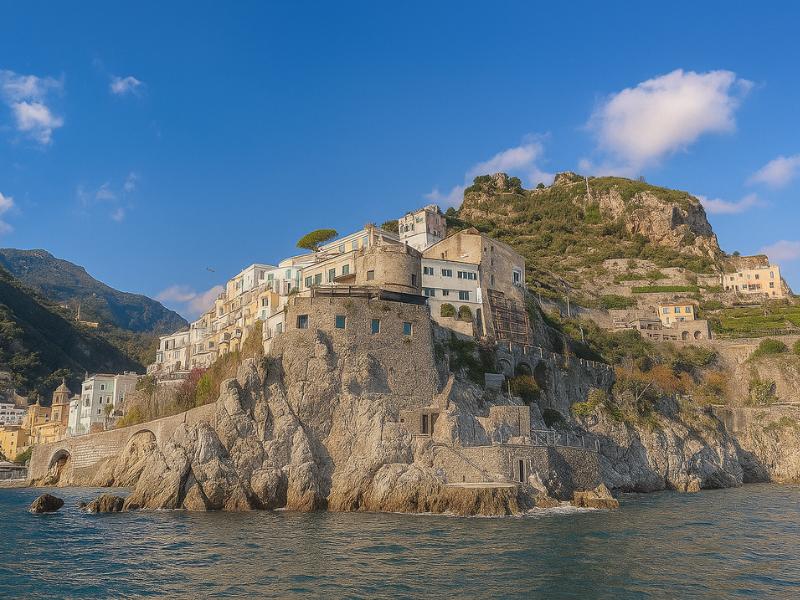
Amalfi has 4,548 residents and once ran a Mediterranean trading empire. It declared independence in 839 and was governed by a ruler whose title had become Doge by 958, and its sea law, the Tavole Amalfitane, stayed in force across the Mediterranean until the 16th century. Everything visitors walk through today is the leftover of that.
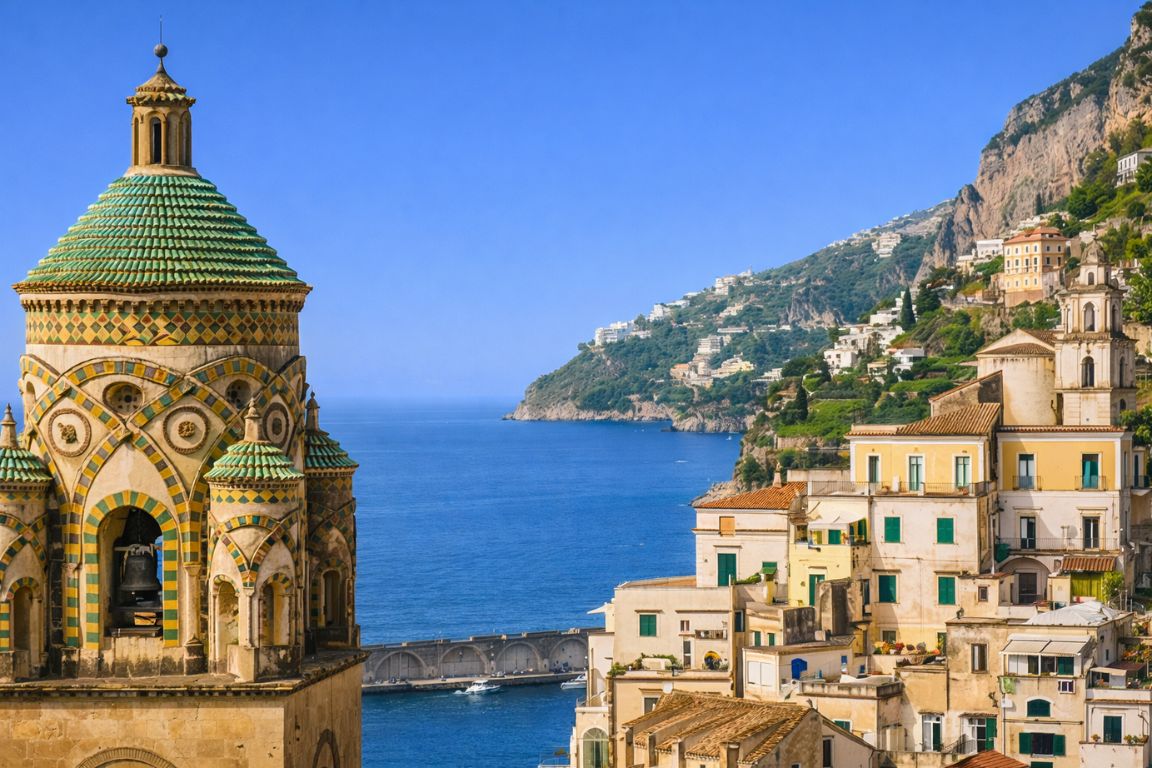
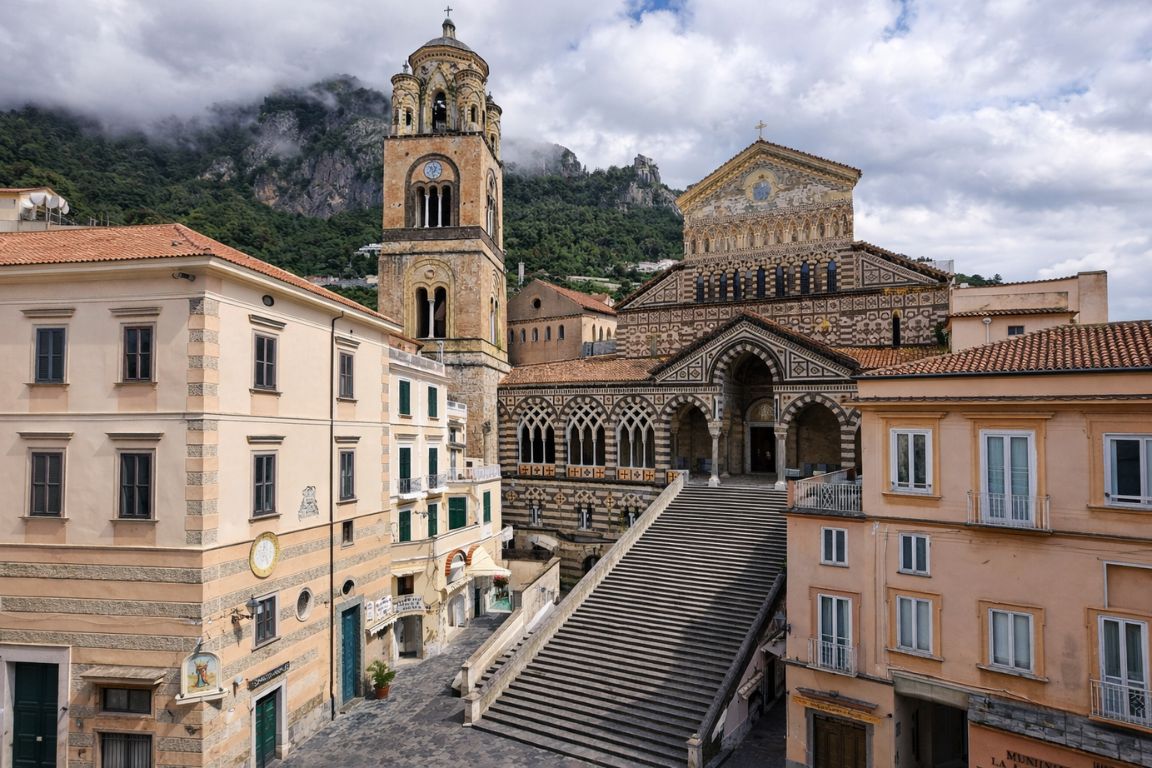
Start at the Cloister of Paradise beside the cathedral rather than the cathedral steps themselves. It was built between 1266 and 1268 for Archbishop Filippo Augustariccio as a burial ground for Amalfi's noble families, and its 120 slim paired columns carry pointed arches in an openly Moorish style that say more about who Amalfi traded with than any museum caption. The cathedral behind it was begun under Duke Mansone I from 987. Its bronze doors were cast in Constantinople before 1066 and are the earliest post-Roman bronze doors in Italy, and the relics of Saint Andrew arrived from Constantinople in 1206, with the crypt finished to receive them two years later.
The Tavole Amalfitane are worth a second look for anyone who likes the mechanics of history. The first 21 chapters are in Latin and date to the 11th century; the remaining 45 were added in the vernacular in the 13th. The town's other real claim is paper. Amalfitans learned papermaking from the Arabs, and charta bambagina, made from pulped linen, cotton and hemp rags rather than wood, is documented here from the 13th century. Frederick II banned it for notarial documents in 1220 on the grounds that it lasted less well than parchment, and Amalfi kept making it anyway: around twenty mills were still working in the 18th century. The flood of November 1954 destroyed nearly all of them, leaving three families in business, and one former mill in the Valle dei Mulini became the Museo della Carta in 1969.
Amalfi is also the only town on the coast that feels like a town rather than a viewpoint. It has a supermarket, a post office, schools and a bus station. That matters when you want lunch at two o'clock in November. What ended its greatness was not conquest but water: a tsunami in 1343 destroyed the port and the lower town, and it never recovered beyond local importance. Local tradition also credits Amalfi with Flavio Gioia, traditionally named as the man who brought the mariner's compass to Europe, a claim historians treat as legend rather than record.
Give the paper valley time of its own after the historic centre. A town stop does not include museum admission by default. Plan Amalfi’s paper heritage
Positano: The Vertical Village That Sold The Coast To The World
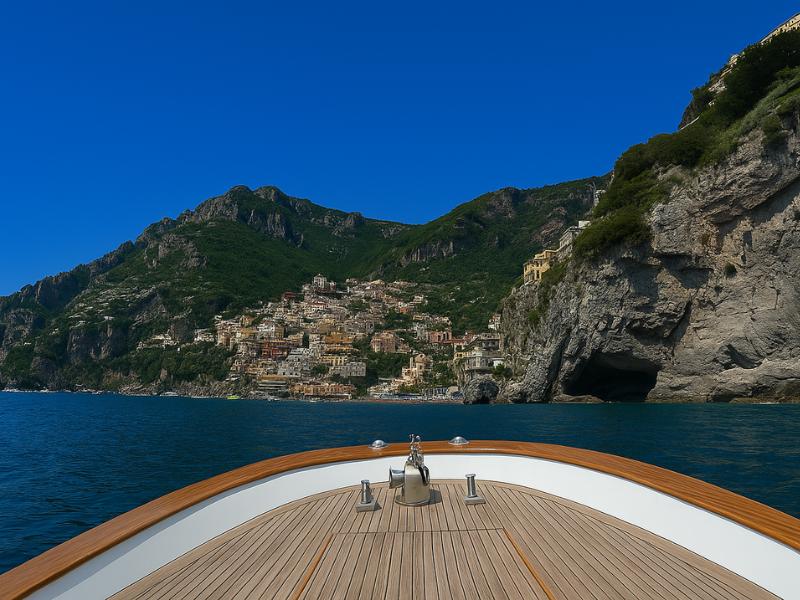
Positano has 3,647 residents and is built almost entirely on a slope, so nearly every route through it is a staircase. Its fame is largely one man's doing: John Steinbeck published an essay titled "Positano Bites Deep" in Harper's Bazaar in May 1953, and it turned a quiet fishing village into a destination within a decade.
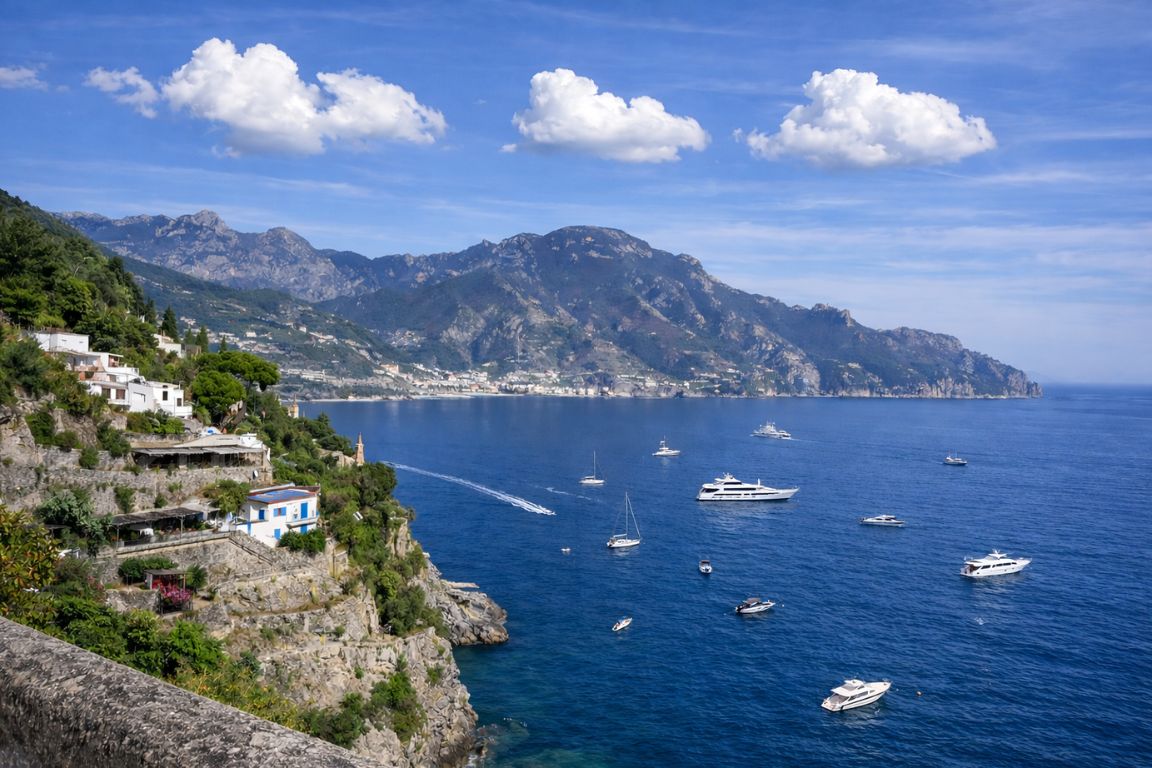
One sentence of his still gets quoted on half the hotel websites in town: "It is a dream place that isn't quite real when you are there and becomes beckoningly real after you have gone." What he saw was a village of pastel houses stacked on top of each other around a beach. What exists now is the same village with the ground floors converted to boutiques, but the geometry has not changed, and that geometry is why the photographs work. Two hamlets sit above it, Montepertuso and Nocelle, and Nocelle is where the Path of the Gods comes down off the ridge.
The building everyone photographs is the church of Santa Maria Assunta, whose dome is covered in majolica tiles. Inside is a 13th-century Byzantine icon of a black Madonna, and the town's origin story is attached to it: pirates carrying the stolen icon hit a storm off the coast, heard a voice from the cargo saying "Posa, posa" (put it down), landed the icon here, and the storm dropped. The best known of its beaches are Spiaggia Grande, the main one below the church, and Fornillo, the quieter second beach about ten minutes west along a cliff path from the pier. Neither is soft sand; both are coarse dark grey sand mixed with pebbles, and most of each is given over to paid lido sections with a smaller free stretch alongside. Fornillo is the cheaper of the two for a sunbed.
Ravello: The Town 350 Metres Above Everything Else
Ravello sits 350 metres up on the ridge behind Atrani, with 2,333 residents, no beach and no ferry landing. English Wikipedia puts it at exactly 782 stairs above Atrani. What it has instead are two cliff-edge gardens that most people rate the best views on the coast.
Villa Rufolo was built in 1270 by Nicola Rufolo and was already famous enough by the 14th century for Boccaccio to put it in the Decameron. Richard Wagner visited in 1880 and took the garden as his mental image for Klingsor's magic garden in Parsifal, which is why the Ravello Festival, running since 1953, was founded in his honour and still stages orchestral concerts on a platform built out over the drop. The other garden is Villa Cimbrone, whose Terrace of Infinity is the balustrade lined with marble busts that appears in roughly every second image of the coast.
Ravello has a long habit of attracting people who wanted to be left alone. Gore Vidal kept his Italian home here, La Rondinaia, built in the 1930s on the cliff face, until 2004. M.C. Escher, Virginia Woolf and Leonard Bernstein all spent time here too. In the 12th century the town held something like 25,000 inhabitants, ten times today's figure, back when it was a wealthy trading satellite of Amalfi. The practical consequence of all that altitude is simple: getting to Ravello means the SITA bus up from Amalfi, about 25 to 30 minutes, a taxi, or a long stepped climb from sea level, and the last bus down is earlier than most people expect.
Praiano: The Working Village Between The Two Famous Ones
Praiano, 1,916 residents, sits on the cliffs between Amalfi and Positano and is the most realistic compromise on the coast: real village life, a fishing cove at Marina di Praia, and prices below its neighbours. Its name comes from the Latin pelagium, open sea, and in the 10th and 11th centuries it was the summer residence of the doges of Amalfi.
Praiano is spread rather than clustered, which is why it does not photograph as one image the way Positano does. Its church of San Luca Evangelista dates back to 1123 and holds Renaissance paintings by Giovanni Bernardo Lama, and the church of San Giovanni Battista keeps a well-preserved maiolica-tiled floor from the 12th or 13th century. The frazione of Vettica Maggiore is named in the UNESCO inscription for the coast in its own right. Marina di Praia is a narrow cove wedged into a gorge with a handful of restaurants and a small fleet of boats, reached by a path down from the road, and the Madonna procession from Positano lands there at the end of March.
The village looks west along the coast toward Positano, which sounds trivial and is not. Amalfi loses the sun behind its ravine walls in the late afternoon. Praiano's terraces keep it, and they are where people here go at the end of the day. Its historic trades were silk, then coral, then fishing, then this.
Plan Praiano around the particular cove and its access; a boat passing the shoreline does not guarantee a landing there. Compare the nearby coves
Atrani: The Smallest Municipality In Italy
Atrani covers 0.12 square kilometres, or 12 hectares, making it the smallest comune in the whole of Italy by area, and holds 744 residents. The next smallest municipality in the country is more than five times its size. It sits ten minutes on foot from Amalfi around a headland, yet almost nobody walks the ten minutes, which is why it stays the most intact village on the coast.
Atrani was the twin town of Amalfi inside the medieval duchy, and the two shared a privilege no other settlement had: only Amalfi and Atrani could elect or depose the duchy's leaders. The 10th-century church of San Salvatore de' Birecto was the palace chapel where the rulers were crowned with the ceremonial cap called the birecto and where their ashes were later deposited. Its bronze doors, cast in 1087, now hang in Santa Maria Maddalena. Atrani's residents kept a separate identity for centuries, calling themselves Atranese while everyone else in the duchy was simply Amalfitani.
None of that is why to go. The reason is that Atrani still functions as a village: one small square opening on to the water, laundry across the alleys, children playing where coaches cannot reach. It takes twenty minutes to walk and stays in the memory longer than that.
Add a self-guided walk through Atrani’s public square and lanes to an Amalfi day. Explore Atrani’s film locations
Furore: A Village With No Centre And A Fjord That Is Not A Fjord
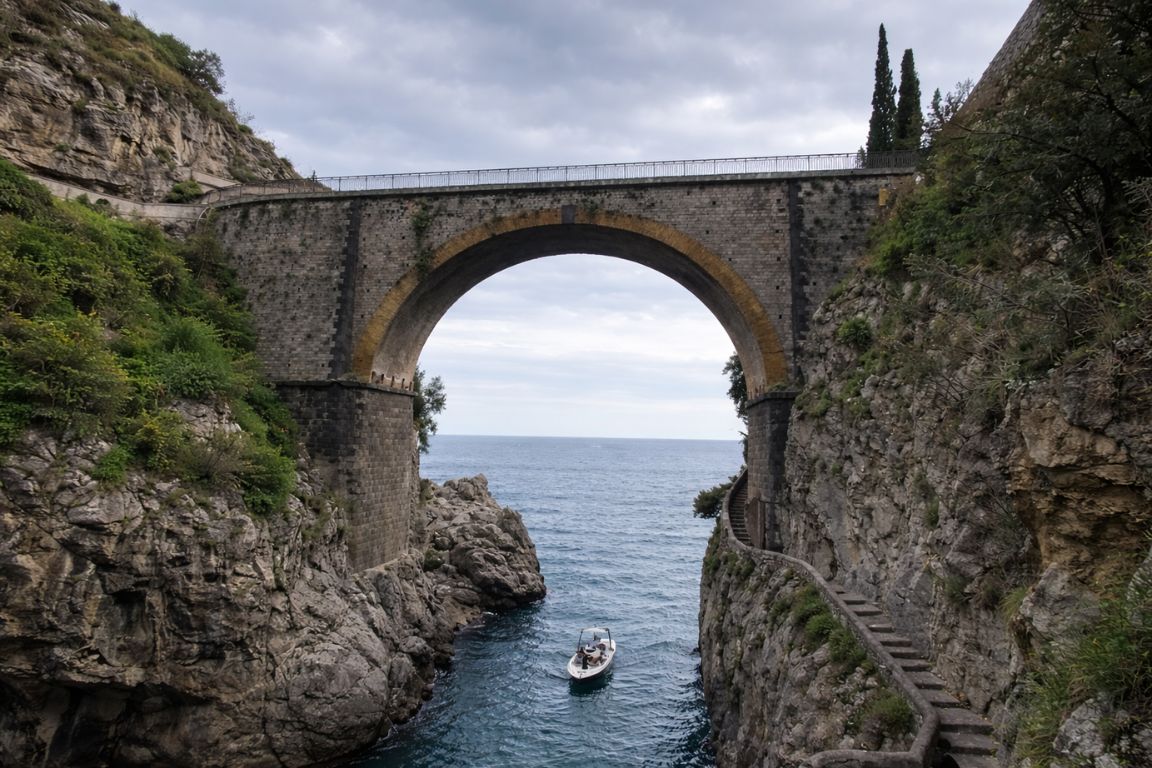
Furore has 668 residents, sits around 300 metres up, and has no piazza, no high street and no obvious middle. Its houses are scattered across terraces. The famous inlet below it is not a fjord at all: it is a ria, a drowned river mouth cut by the Schiato torrent running down from Agerola.
The distinction matters if you are expecting Norway. A fjord is carved by a glacier. What Furore has is a narrow rock cleft where a mountain stream reaches the sea, spanned by the coast road on a high bridge, with a handful of old fishermen's houses at the bottom and a small strip of shingle. Photographed from the bridge it is one of the most striking things on the coast. Standing at the bottom in July it is small and busy. Roberto Rossellini and Anna Magnani lived in that hamlet and filmed there.
Two other reasons to stop. Furore runs an open-air mural museum, paintings applied directly to the walls of houses along the road, a deliberate response to having no historic centre to show visitors. And the bridge over the inlet hosts a stage of the world high-diving championship each year on the first Sunday of July, which is worth planning around in either direction depending on your taste for crowds.
Pair the inlet’s scenery with the coast’s film history, and verify local access before setting out for the descent. Explore the coast’s film connections
Conca Dei Marini: A Sea Cave, A Watchtower And A Pastry
Conca dei Marini is the smallest comune on the coast by population, at 643 residents, and sits on a headland between Amalfi and Furore. Its draw is underground: the Grotta dello Smeraldo, a karst sea cave found by a fisherman named Luigi Buonocore in 1932 and reached by lift from the road or by boat.
The Emerald Grotto is a flooded limestone cavern about 45 metres long and 32 deep, with a roof some 24 metres above the water. It has no natural opening above the waterline, which is why nobody found it until 1932, and it is exactly that submerged fissure that turns the whole interior green as light filters through. Since 1956 a ceramic nativity scene has sat on the cave floor underwater. The visit takes ten to fifteen minutes in a rowing boat and divides opinion sharply. Rough seas close it.
Above it, the village is quiet to the point of being empty. Capo Conca Tower, a 16th-century sea watchtower, sits on the headland as a reminder of what this coast spent centuries worrying about: Conca dei Marini was sacked by Turkish pirates in 1543. The village has one further claim, and it is a good one. Local tradition holds that the sfogliatella was invented in the 18th century at the Conservatorio di Santa Rosa here, when nuns used up leftover dough with a filling of semolina cream, milk, sugar, dried fruit and their own candied cherries.
Keep grotto admission and sea conditions separate from your transport booking; a coastal cruise does not necessarily enter the Emerald Grotto. Compare the cave experiences
Minori And Maiori: The Two Flat Towns With Real Beaches
Minori (2,521 residents) and Maiori (5,220) sit side by side east of Amalfi, both at 5 metres above sea level, and they are the two flattest towns on the coast. Maiori has the longest unbroken stretch of beach on the whole coastline. Both cost noticeably less than their western neighbours.
Minori's headline sight is a Roman seaside villa from the 1st century AD, originally built on two floors of which only the lower survives, still carrying frescoes and mosaics. It was first uncovered between 1950 and 1954 and dug again after the flood. Archaeologically it makes Minori the oldest inhabited site on the coast, which is a claim Scala also makes on the strength of legend rather than evidence. The Basilica of Santa Trofimena holds the relics of the patron saint in its crypt and was raised to minor basilica in 1910. Minori is also a food town with a real claim rather than a marketing one: ndunderi, made here, are described as one of the oldest forms of pasta still in production, alongside local shapes like riccio and lagane.
Maiori is bigger, covering 16.67 square kilometres against Minori's 2.66, and its long seafront was largely rebuilt in the modern era, so it looks less medieval than its neighbours. The beach runs close to a kilometre of dark volcanic sand with around fifteen bathing establishments along it, which is why families who actually intend to swim end up here rather than in Positano. That flat kilometre exists because of a catastrophe: the flood of 25 October 1954 killed 318 people across the province, 37 of them in Maiori, and the debris it carried down built the land the beach now sits on. Maiori also has the coast's strongest film credentials. Roberto Rossellini shot four films here, Paisà in 1946, the segment "Il Miracolo" from L'Amore in 1948, Machine to Kill Bad People in 1952 and Journey to Italy in 1953. Its Collegiate Church of Santa Maria a Mare dates to the 13th century, with a colourful maiolica-tiled dome on a 14th-century bell tower.
| Minori | Maiori | |
|---|---|---|
| Residents | 2,521 | 5,220 |
| Land area | 2.66 km2 | 16.67 km2 |
| Elevation | 5 m | 5 m |
| Beach | Short town beach | Longest unbroken beach on the coast |
| Headline sight | 1st-century Roman villa | Santa Maria a Mare, 13th century |
| Best for | A quiet, walkable half day | Families who want to swim |
The two are linked by the Sentiero dei Limoni, a stepped path through the lemon terraces above them, which is the gentlest of the coast's walking routes and the only one that connects two towns without a bus.
If swimming is the priority, compare Maiori and Minori’s shore access before adding a wider excursion. Plan an eastern-coast beach day
Scala And Tramonti: The Two You Reach By Driving Uphill
Scala (1,511 residents, 360 metres up) and Tramonti (4,208 residents, 321 metres up) are the coast's only two landlocked comuni. Neither touches the sea at any point. Both are where you go when the coast road has stopped being fun and you want terraces, vines and silence instead.
Scala faces Ravello across the Dragone valley and covers 13.86 square kilometres of ridge and woodland. Tradition says Roman shipwreck survivors bound for Constantinople founded it in the 4th century, which would make it the oldest settlement on the coast, though the story is not historically demonstrated and Minori has the better archaeological case. Its Duomo keeps a medieval crypt, and its firmest historical claim is religious: the Congregation of the Most Holy Redeemer, the Redemptorists, was founded here by Saint Alphonsus Maria de' Liguori. Visitors come mostly for the walking, because the paths from Scala give you Ravello and the sea in the same frame.
Tramonti is different again. It is not one village but thirteen scattered hamlets across nearly 25 square kilometres, with names like Campinola, Gete, Pucara and Polvica, and its road runs over the Valico di Chiunzi rather than along the coast. It is the largest comune on the coast by area and the greenest by some distance, covered in vineyards, lemon orchards and chestnut woodland. If you want to understand where the coast's food and wine actually come from, this is the answer, and it is the one comune on the list where a car genuinely helps.
Four of the thirteen sit well above the coast road, and they are a different kind of day out from the seafront villages. Each needs a climb, and each rewards it differently.
| Village | Height | What is up there | How you get up |
|---|---|---|---|
| Ravello | 350 m | Villa Rufolo, Villa Cimbrone, summer concerts | SITA bus from Amalfi, 25 to 30 minutes |
| Scala | 360 m | Ridge paths, a medieval crypt, near silence | Bus or car from Amalfi |
| Tramonti | 321 m | Thirteen hamlets, vineyards, chestnut woods | Car over the Valico di Chiunzi from Maiori |
| Furore | about 300 m | Murals, terraces, the fjord below | Coast road bus, then steps down or up |
Keep Tramonti’s farm country and Scala’s walking lanes on their own route. The featured coast-three-town day does not promise either stop. Explore the region’s food traditions
Cetara And Vietri Sul Mare: Anchovies And Ceramics At The Eastern End
Cetara (1,870 residents) is still a working tuna port, and its colatura di alici is a direct descendant of Roman garum, protected with DOP status by the European Union in October 2020. Vietri sul Mare (6,836 residents) is the largest of the thirteen and the coast's eastern gate, separated from the Port of Salerno by little more than a harbour wall.
Cetara's name gives the game away. It comes from the Latin Cetaria, related to the Greek term for a tuna trap, and the village has been a fishermen's settlement, tuna above all, for as long as records exist. The colatura is made by layering gutted anchovies with salt in small chestnut or oak barrels under a weighted disc, decanting the liquid that rises, and leaving it in direct sun for four or five months to concentrate before it is poured back through the fish and filtered through linen. It is ready in early December. The DOP rules require every stage to happen in the Province of Salerno, with the fish caught within twelve nautical miles of the coast. A 16th-century tower still guards the harbour, one of a chain of nineteen ordered along this coastline after Turkish raiders sacked the town in 1551. Cetara is a real port that happens to be beautiful, not a beautiful place that keeps a token boat.
Vietri sul Mare climbs a slope at 80 metres above the water across 9.52 square kilometres, and its shops are stacked with hand-painted plates, tiles and jugs. Ceramics have been made here since the late Renaissance, and the Museo Provinciale della Ceramica sits in the village of Raito just above the town. There is a stranger piece of ceramic history too: German artisans who stayed on after the Allied landing at Salerno were chemists as well as potters, and the yellow now identified with Vietri came out of that period. Because Vietri is the first place you reach coming from Salerno, most people pass through it in the first ten minutes of a coastal drive and never stop, which is the wrong way round. It is the cheapest place on the coast to buy something made where you are standing.
Make the eastern pair a purposeful shopping-and-food day rather than an unplanned stop on the way west. Plan Cetara and Vietri purchases
Which Villages Actually Have A Beach?
Nine of the thirteen have usable shoreline, but only Maiori and Minori are flat, wide and easy. Maiori's is the longest unbroken beach on the coast, close to a kilometre of dark volcanic sand. Ravello, Scala and Tramonti have nothing at the town, and Furore's is a strip of shingle at the bottom of a ravine.
Almost none of it is soft golden sand. The coast's beaches are coarse dark sand mixed with pebble, wedged into coves under cliffs, and most are divided between paid lido sections and a smaller free stretch. Access is the real variable, and it is what separates a swim from an expedition.
| Village | Beach | Getting down to it |
|---|---|---|
| Maiori | Longest on the coast, near a kilometre | Flat, straight off the seafront road |
| Minori | Short town beach, flat | Flat, off the seafront |
| Positano | Spiaggia Grande and Fornillo | Staircases from the road; Fornillo is a cliff path |
| Amalfi | Marina Grande, opposite the centre | Flat, across the seafront road |
| Cetara | Working harbour beach | Short walk from the road |
| Vietri sul Mare | Marina di Vietri, below the town | Descent from the village at 80 m |
| Atrani | Small beach off the one square | Flat once you are in the village |
| Praiano | Coves, including Marina di Praia | Steps down a gorge from the road |
| Furore | Shingle strip inside the inlet | Long staircase from the bridge |
| Conca dei Marini | Small cove below the headland | Steep descent |
| Ravello | None at the town | Bus or taxi down to Amalfi or Minori |
| Scala | None, landlocked | Not applicable |
| Tramonti | None, landlocked | Road down to Maiori |
Compare the route from town to beach before choosing; the presence of a shoreline does not mean easy water access. Check the beach access table
Which Is The Prettiest Town On The Amalfi Coast?
Positano wins on the single photograph, because no other village stacks that many coloured houses into one frame. Ravello wins on the view out, since being 350 metres up beats being in the picture. Atrani wins on being an intact village rather than a stage set. Which one is prettiest depends entirely on which of those three things you actually want.
The honest version of this question is worth spelling out, because the answer people give changes after they have been. Positano is spectacular from the water and from the road above, and considerably less spectacular at eye level in August. The scale of the imbalance is the point: the village has around 3,600 residents, and published estimates put average daily visitor numbers at roughly 12,000 between Easter and October. That is three visitors for every resident, every day, for seven months, on a hillside where the main street is a staircase. Ravello never has that problem, because there is nothing to queue for except the two villas, and the gardens absorb visitors easily. Atrani has no famous view at all and is often the place people remember most, precisely because nothing there is arranged for them.
If prettiness means an unbroken historic core with no modern building in sight, the answer is Atrani or the upper lanes of Scala. If it means the classic Amalfi Coast image, it is Positano from the sea. If it means the widest sweep of coastline in one look, it is the Terrace of Infinity at Villa Cimbrone.
Put the swimming day on your itinerary first, then arrange your journey to Amalfi or Positano. See the cliffs from the water and take swimming breaks, with snorkeling gear and drinks included. Choose Your Coast-Cruise Date
How Long Should You Spend In Each Village?
Amalfi and Positano need about three hours each to be more than a photo stop. Ravello needs two, plus travel up and down. Everything else on the coast is a one-hour village, and that is not a criticism: most of the thirteen are small enough to walk end to end in twenty minutes.
The mistake most first trips make is even distribution. Giving every stop ninety minutes produces a day where you saw nothing properly and spent four hours on a bus. Two towns done well beats five done badly, and the timings below assume you actually get out and walk rather than photographing from the road.
| Village | Time to give it | What that buys you |
|---|---|---|
| Amalfi | 2.5 to 3 hours | Cathedral, cloister, paper mill valley, lunch |
| Positano | 3 hours | Walk down, church, beach, walk or shuttle back up |
| Ravello | 2 to 3 hours | Both villas and their gardens, plus the square |
| Praiano | 1.5 hours | Marina di Praia, the church, a sunset drink |
| Atrani | 45 minutes | The whole village, on foot from Amalfi |
| Furore | 30 to 45 minutes | The fjord bridge, the beach below, the murals |
| Conca dei Marini | 45 minutes | The Emerald Grotto and the headland |
| Minori | 1 hour | Roman villa, basilica, a pastry |
| Maiori | Half a day | Actual swimming time on the long beach |
| Scala | 1 to 2 hours | The lanes, the crypt, the view across to Ravello |
| Tramonti | Half a day | A winery, a farm lunch, the Chiunzi pass |
| Cetara | 1.5 hours | Harbour, tower, an anchovy lunch |
| Vietri sul Mare | 1 hour | Ceramic workshops and the museum at Raito |
How can Positano, Amalfi and Ravello fit into one outing? Visit Positano, Amalfi and Ravello on a guided day from Sorrento, with free time in the towns. Discover Positano, Amalfi & Ravello
Which Villages Can You Reach By Ferry, And Which Need The Road?
Scheduled coastal ferries call at Salerno, Vietri sul Mare, Cetara, Maiori, Minori, Amalfi and Positano, plus Sorrento and Capri off the coast proper. Everything else is road-only. Praiano, Conca dei Marini and Furore have a shoreline but no scheduled service, and Ravello, Scala and Tramonti are reached by climbing away from the water rather than along it.
This single distinction shapes a summer itinerary more than any other. The coast road is one lane in each direction for most of its 40 kilometres, and in July and August it moves at the speed of the slowest coach on it. A boat covers Positano to Amalfi in about 20 minutes against roughly 45 by bus in good traffic, and it does it with a view of the villages from the angle they were built to be seen from. The catch is weather. Positano in particular has no true port, only a small pier that closes when the sea is rough, and the coastal routes largely run from around early April to the end of October rather than year-round.
| Village | Ferry landing | On the SS163 coast road | Practical way in |
|---|---|---|---|
| Positano | Pier, weather permitting | Yes, above the town | Ferry, or bus then stairs down |
| Praiano | No scheduled service | Yes, through the village | Bus or car |
| Furore | No | Yes, over the bridge | Bus or car, then steps |
| Conca dei Marini | No | Yes | Bus or car, plus a lift to the grotto |
| Amalfi | Yes, a real port | Yes, the road hub | Ferry or bus, both end at the seafront |
| Atrani | No scheduled service | Yes, the road passes over it | Ten-minute walk from Amalfi |
| Ravello | No | No | Bus up from Amalfi, 25 to 30 minutes |
| Scala | No | No | Bus or car up from Amalfi |
| Minori | Yes | Yes | Ferry, bus, or the lemon path from Maiori |
| Maiori | Yes | Yes | Ferry or bus along the seafront |
| Tramonti | No, inland | No | Car over the Valico di Chiunzi |
| Cetara | Yes | Yes | Ferry or bus from Salerno or Amalfi |
| Vietri sul Mare | Yes | Yes, the eastern end | Ferry or a short hop from Salerno |
One bus line worth knowing is SITA 5120, which runs Salerno to Amalfi calling at Vietri sul Mare, Cetara, Minori and Maiori in about an hour, so the whole eastern half of the coast is reachable on one ticket. The coastal ferry operator also runs a shuttle up to Agerola and the hamlet of Bomerano, the standard trailhead for the Path of the Gods, so the boat is not only useful for town-hopping.
Use scheduled ferry and bus routes for town hopping; sightseeing cruises have their own routes and return points. Plan public transport between towns
Which Village Suits Which Traveller?
Match the village to what you want from the day rather than to its reputation. The three famous names suit three genuinely different trips, and half the coast's best hours happen in villages nobody has heard of.
| If you want | Go to | Why |
|---|---|---|
| The classic image | Positano | Nothing else looks like it, especially from the water |
| A real town with history | Amalfi | Cathedral, cloister, paper mills, year-round life |
| Gardens and long views | Ravello | Two cliff-edge villas, 350 m up, no through traffic |
| Sunsets and lower prices | Praiano | Faces west, keeps the light, still a village |
| Somewhere untouched | Atrani | Smallest comune in Italy, ten minutes from Amalfi |
| To actually swim | Maiori | The longest unbroken beach on the coast |
| Food with a real story | Cetara or Minori | Anchovy sauce descended from garum; ancient pasta shapes |
| Wine and farmland | Tramonti | Thirteen hamlets of vines, lemons and chestnuts |
| Something to take home | Vietri sul Mare | Ceramics made in the town since the 15th century |
| A short, strange detour | Furore | A ria under a bridge and painted house walls |
| Quiet walking | Scala | Ridge paths above Amalfi with almost nobody on them |
| One striking natural sight | Conca dei Marini | The Emerald Grotto, weather permitting |
Choose the outing before filling the rest of your day. Compare three-town day and coast cruise by departure points and the time each experience takes. Choose Your Three-Town Day Or Alternative
How Many Villages Can You Honestly See In One Day?
Three, comfortably. Four if two of them are next door to each other, like Amalfi and Atrani or Minori and Maiori. Five is a bus tour of car parks. The road is 40 kilometres long, single lane most of the way, and moving 15 kilometres along it in summer can take an hour.
The combination that works best for a first visit is Positano, Amalfi and Ravello, because the three are genuinely different from one another and sit in a sensible line. Positano gives you the view, Amalfi gives you the history and lunch, Ravello gives you the height. Add Atrani free of charge by walking round the headland from Amalfi while everyone else queues for the bus. That sequencing is exactly why most Italy Amalfi Coast Tours combine three or four of these villages into a single day rather than trying to cover the whole thirteen.
If you have a second day, spend it going the other way. Minori, Maiori and Cetara are quieter, cheaper and closer together, and the eastern half of the coast road is less congested because most day trips turn around at Amalfi. A third day belongs uphill, in Tramonti or Scala, where the coast stops being a view and starts being a place people farm.
Want to include Ravello as well as the waterfront towns? For a first day from Sorrento, the listed Positano–Amalfi–Ravello route matches the three-town approach. Discover Positano, Amalfi & Ravello
Which Villages Are Worth Skipping?
None of the thirteen is bad, but several are not worth a dedicated stop on a short trip. Conca dei Marini without the grotto, Furore in the middle of the day, and Scala without the time to walk are all better left for a return visit.
Be specific about why. The Emerald Grotto closes in rough seas, and Conca dei Marini above it is a scattering of houses on a headland with almost nothing to do, so a stop there with the grotto shut is fifteen wasted minutes. Furore is a bridge and a photograph unless you take the steps down, which needs half an hour and reasonable knees. Scala is genuinely lovely and completely pointless as a fifteen-minute coach stop, because everything good about it is on foot and takes an hour.
The reverse also holds. Atrani takes no planning at all and rewards everyone, because it is a short walk from where the buses already stop. Vietri sul Mare is often skipped simply because it comes first and people are impatient to reach the famous names, which is the weakest reason of the lot.
Skip a stop when its particular appeal is unavailable or does not interest you, and put that time into the town that does. Refine your village shortlist
Frequently Asked Questions
How many towns are on the Amalfi Coast?
Thirteen: Positano, Praiano, Furore, Conca dei Marini, Amalfi, Atrani, Ravello, Scala, Minori, Maiori, Tramonti, Cetara and Vietri sul Mare, all in the Province of Salerno. The coast was inscribed as the Costiera Amalfitana UNESCO World Heritage Site in 1997, covering 11,231 hectares, though the heritage boundary technically takes in fifteen comuni by adding two inland municipalities over the ridge. Sorrento, Capri and Salerno are commonly visited alongside the coast but are not part of it.
Which is the smallest town on the Amalfi Coast?
Atrani, at 0.12 square kilometres, which also makes it the smallest municipality in the whole of Italy by area, more than five times smaller than the next one. It has 744 residents and sits about a ten-minute walk from Amalfi around the headland. Conca dei Marini is the smallest by population, with 643 residents.
Which Amalfi Coast towns have no beach?
Ravello, Scala and Tramonti. Ravello and Scala sit on the ridge above Amalfi at 350 and 360 metres, and Tramonti lies inland in a valley connected to the sea only by the road down to Maiori. Ravello's territory does reach the water at the hamlet of Castiglione, a couple of hundred steps below the coast road, but there is no beach or harbour at the town itself. Everywhere else has some form of shoreline, though most are pebble and coarse sand rather than soft sand.
Which town has the best beach on the Amalfi Coast?
Maiori has the longest unbroken stretch of beach on the coastline, close to a kilometre of dark volcanic sand with around fifteen bathing establishments, and it is flat and easy to reach. That makes it the practical choice for anyone who actually wants to swim. Positano's Spiaggia Grande is more famous and more photogenic, but it is coarse sand mixed with pebbles, reached by staircase, and largely divided into paid lido sections with a smaller free stretch.
How many towns can you see in one day on the Amalfi Coast?
Three comfortably, or four if two of them adjoin, such as Amalfi and Atrani. The coast road runs 40 kilometres and is single lane for most of its length, so summer traffic, not distance, sets the limit. Positano, Amalfi and Ravello is the standard first-visit combination because the three are genuinely different from each other.
Have your travel day in mind? Match departure points and the time each experience takes before making separate activity bookings. Choose Your Three-Town Day Or Alternative