Best Beaches On The Amalfi Coast: Which Ones Are Actually Worth It
The first thing to understand about swimming on the Amalfi Coast is that almost none of it is sand. The cliffs drop straight into the Tyrrhenian, the shoreline is pebble, shingle and coarse grey grit, and half the good coves have no road at all. That changes how you choose. This guide sorts every beach worth the trip by what it is made of, how you get down to it, what a lounger costs, and which ones only a boat can reach.
Choose your shore access first. A coastal boat day is an alternative for seeing the cliffs and swimming when conditions allow, not a taxi to every beach in this guide. Choose Your Experience Below.
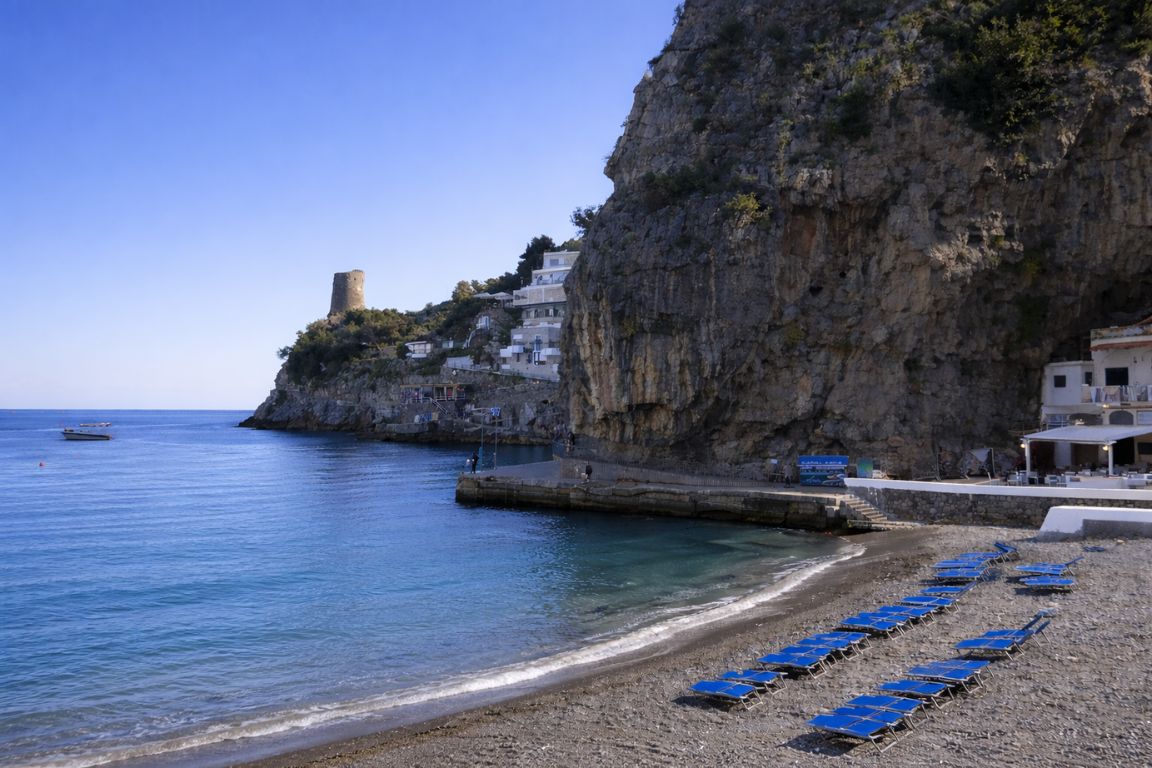
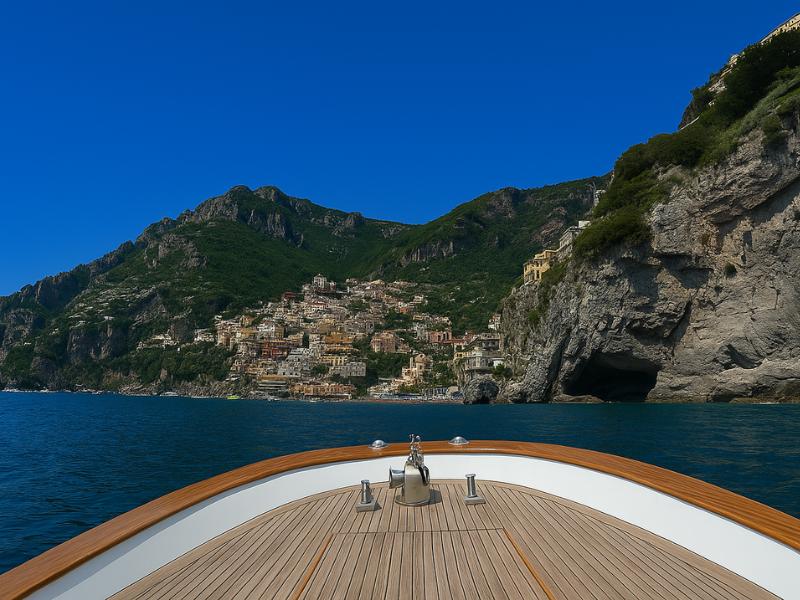
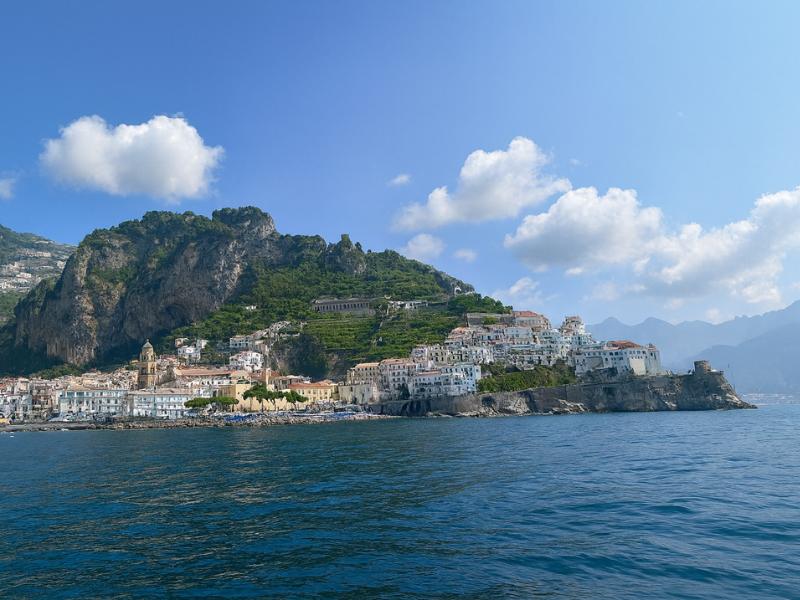
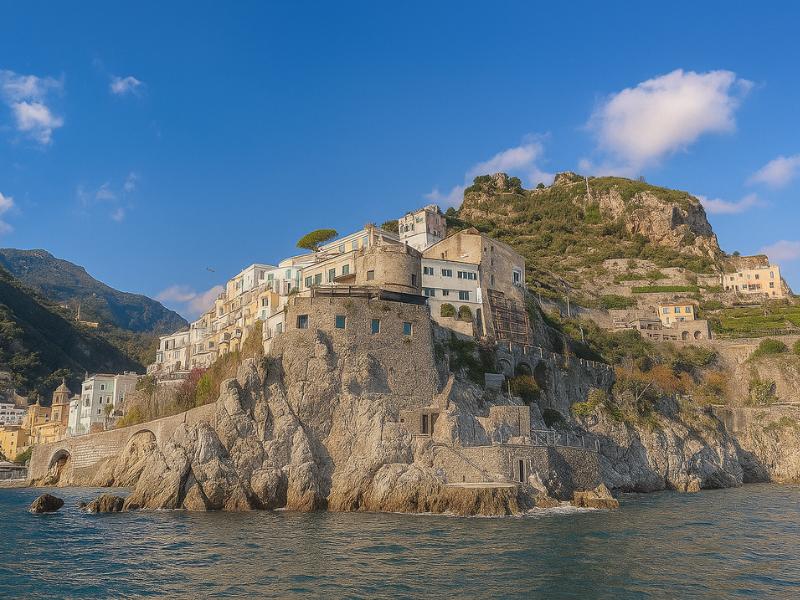
People arrive expecting a Mediterranean beach holiday and find something closer to a mountain range that happens to end in water. The Amalfi Coast runs roughly 50 km along the southern edge of the Sorrentine Peninsula, and the towns are stacked up the cliffs rather than spread along a shore. What passes for a beach here is usually a pocket of shingle at the bottom of a ravine, wedged between rock walls, half of it rented out by the day. Knowing which pockets are worth the descent is most of the planning.
How far down is it? Steps between the road and the water
Step counts are the figures published for each beach by Amalfi Coast access guides, rounded as they are usually quoted. Two of the coves in this set have no stairway at all and are reached only from the sea. Treat these as planning allowances, not surveyed measurements: local stairways get rerouted after storms.
For a simple shore day, use the accessible eastern beaches or Fornillo. For time on the water, compare an Amalfi boat departureAmalfi boat departure and its swim stops; confirm boarding and swimming suitability separately.
Is The Amalfi Coast Sandy Or Pebbly?
Almost every beach on the coast is pebble, shingle or coarse dark grit rather than soft sand. The exceptions are clustered at the eastern end: Maiori, Minori, Atrani and parts of Vietri sul Mare have genuine medium-grain sand. Everywhere west of Amalfi, expect stones underfoot and pack accordingly.
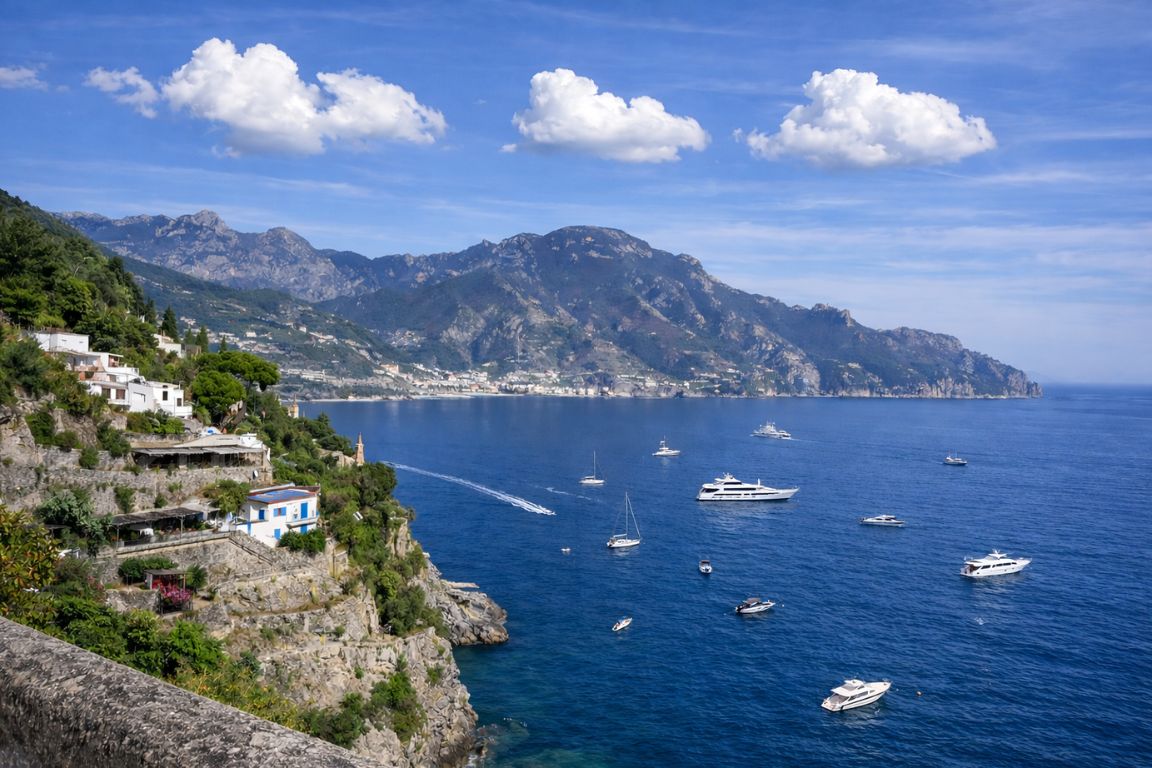
This is geology, not bad luck. The Lattari Mountains meet the sea at a steep angle, and the material that reaches the shore is rock broken down by wave action rather than river-carried sand. Positano's main beach is described in local records as dark sand mixed with pebbles, which in practice means you can walk on it barefoot but you will feel every step. Praiano's Marina di Praia is medium-grain sand studded with stones. Once you get past Amalfi town the valleys widen slightly and the sediment gets finer, which is why the sandiest stretches are all in the last third of the coast road.
The trade-off is worth stating plainly, because it decides whether you enjoy the day. Pebble beaches have clearer water, since there is far less suspended sediment to cloud it. That is the reason the sea here photographs the way it does. It is also the reason a pair of water shoes changes the day more than any other item you pack.
| Beach | Town | What is underfoot | Rough size |
|---|---|---|---|
| Spiaggia Grande | Positano | Dark sand and pebbles | About 300 m |
| Fornillo | Positano | Gravel and pebbles | Small cove |
| Marina di Praia | Praiano | Medium-grain sand with pebbles | Narrow inlet |
| Fiordo di Furore | Furore | Sand and pebbles | About 25 m |
| Duoglio | Amalfi | Sand and pebbles | Small cove |
| Santa Croce | Amalfi | Stones and pebbles | Small cove |
| Atrani | Atrani | Medium-grain sand | Village-width |
| Minori | Minori | Medium-grain sand | About 250 m |
| Maiori | Maiori | Dark volcanic sand | About 900 m to 1 km |
| Erchie | Maiori | Fine sand with a pebbly waterline | About 200 m |
| Marina di Vietri | Vietri sul Mare | Sand, unusually wide | Split by a river mouth |
Pick your surface before packing: a free pebble beach still needs footwear and something comfortable to sit on. Use the pebble-beach packing list
Which Amalfi Coast Beaches Hold A Blue Flag For Water Quality?
Only one town on the whole Amalfi Coast holds a 2026 Blue Flag, and that is Positano, for four beaches: Spiaggia Grande, Fornillo, Arienzo and Laurito. Amalfi, Praiano, Maiori, Minori and the rest of the coast are not on this year's list. Anacapri, across the water, holds one for Gradola beside the Blue Grotto.
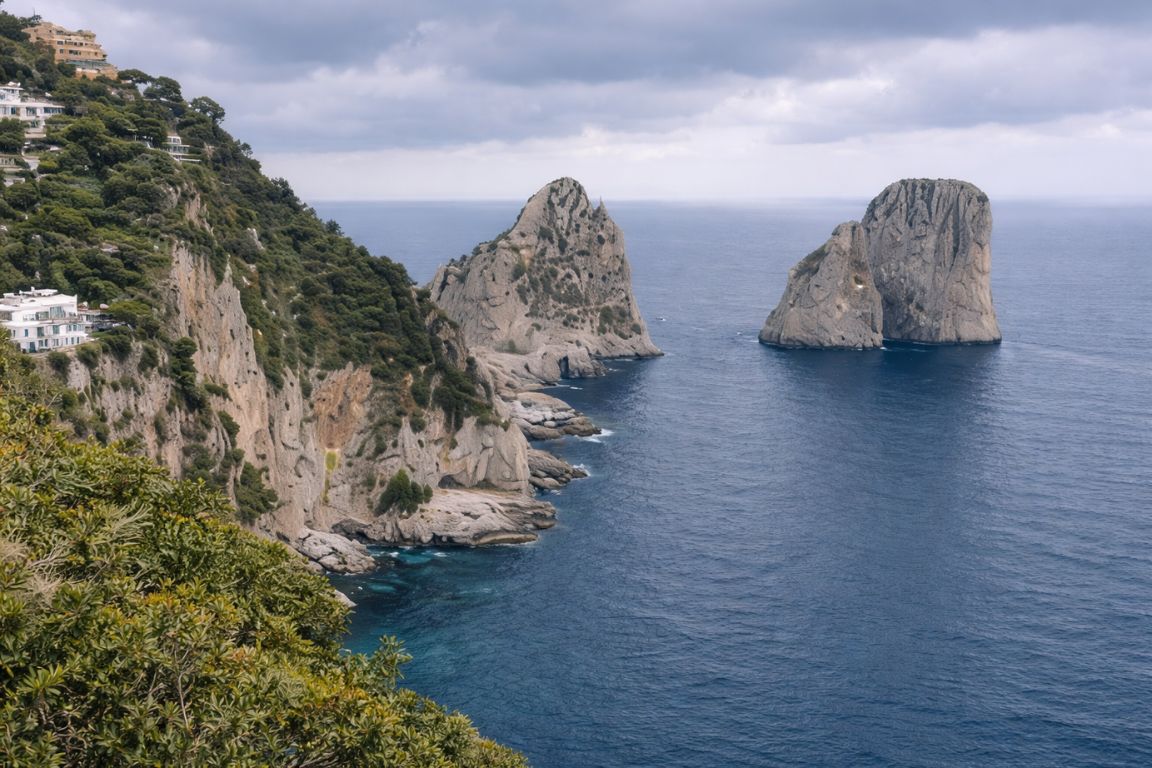
The Blue Flag is run by the Foundation for Environmental Education and awarded to the comune, not to the sea itself, which is the part most visitors get wrong. It scores bathing-water sampling alongside things a swimmer never thinks about: sewage treatment, waste separation, lifeguard provision, accessibility, signage. A town can have beautiful water and still miss the flag because its services fall short, and plenty of the coast's best coves belong to comuni that simply do not apply, on a shoreline that is already a UNESCO World Heritage Site in its own right.
The 2026 national list, published by Italy's tourism ministry, covers 257 comuni and 525 beaches. Campania holds 20 of those comuni, and the Sorrentine Peninsula does far better than the Amalfi side: Massa Lubrense, Sorrento, Piano di Sorrento and Vico Equense all made it, along with Anacapri. Read the coast honestly and the picture is that Positano is the one place here that has put the paperwork and the infrastructure behind its water.
| Comune | Blue Flag beaches, 2026 | Where it is |
|---|---|---|
| Positano | Spiaggia Grande, Fornillo, Arienzo, Laurito | Amalfi Coast |
| Anacapri | Gradola (Grotta Azzurra), Faro Punta Carena | Capri |
| Sorrento | Riviera di Massa, San Francesco, Tonnarella, Puolo | Sorrentine Peninsula |
| Massa Lubrense | Recommone / Marina del Cantone, Marina di Puolo, Giardino Romantico | Sorrentine Peninsula |
| Vico Equense | Scoglio Tre Fratelli, Scrajo Mare, Capo la Gala, Marina di Seiano, Marina di Vico, Punta Orlando | Sorrentine Peninsula |
| Piano di Sorrento | Marina di Cassano | Sorrentine Peninsula |
None of that means the water off Amalfi or Praiano is poor. It means the flag is a service audit as much as a water test, and you should read a missing flag as a missing application rather than a warning.
Choose a beach for its access and facilities as well as any award; an award is not a guarantee of conditions on your swim day. Compare the Positano beaches
Which Beach Should You Choose In Positano?
Spiaggia Grande if you want the postcard and do not mind sharing it, Fornillo if you want the same water with a fraction of the noise, Arienzo if you want afternoon sun and can face 300 steps, and Laurito if you would rather arrive by boat and stay for lunch. All four hold Blue Flags, so the choice is about atmosphere, not quality.
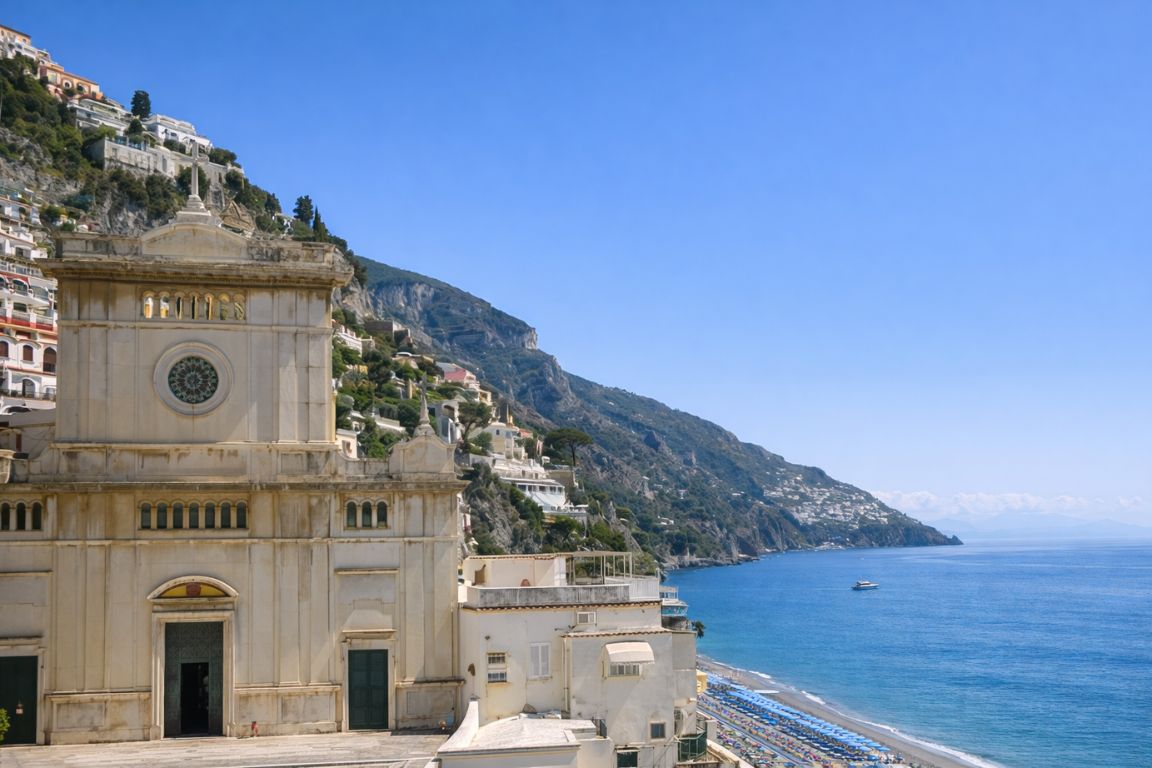
Spiaggia Grande is the one in every photograph, about 300 metres of dark sand and pebbles directly below the church dome, with bathing establishments occupying the middle and free municipal sections at the edges. It is lively to the point of chaotic in August, and it is also where the excursion boats and shuttles leave from, so it doubles as the town's transport hub. Treat it as a place to swim for an hour rather than settle for a day.
Fornillo sits immediately west, reached by a cliff-edge footpath that starts at the harbour and takes about ten minutes. That short walk filters out a surprising number of people. The surface is gravel and pebbles, the setting is quieter, and there are both equipped and free stretches. If someone in your group wants the Positano beach day without the Positano beach crowd, this is the answer.
Arienzo is the local nickname for the 300 steps beach, and the name is accurate. It lies outside town on the road toward Praiano, faces southwest, and holds the sun later into the evening than anywhere else in Positano, which is its whole selling point on a coast where cliffs put most beaches into shade by late afternoon. Laurito is the smallest of the four, reached by a stairway from a small square opposite one of the cliffside hotels, with free and private sections and two beachfront restaurants that run their own boat shuttles from the main harbour.
| Spiaggia Grande | Fornillo | Arienzo | Laurito | |
|---|---|---|---|---|
| Getting there | Walk down through town | 10 min cliff path from the harbour | About 300 steps, or boat | Stairway, or boat shuttle |
| Surface | Dark sand and pebbles | Gravel and pebbles | Sand, gravel, pebbles | Sand and pebbles |
| Free section | Yes, at the edges | Yes | Yes | Yes |
| Crowds | Heaviest on the coast | Moderate | Moderate | Light |
| Afternoon sun | Goes into shade earlier | Goes into shade earlier | Longest of the four | Short, cliff-backed |
| Blue Flag 2026 | Yes | Yes | Yes | Yes |
For a shore-based afternoon, compare the walk, steps and facilities before paying for any excursion. Choose the beach access that fits
What Does A Beach Club Cost, And Where Can You Sit For Free?
Budget roughly 25 to 40 euro per person per day for a lounger and umbrella at a Positano club in high season, with front-row positions costing considerably more. Every major beach on the coast also keeps a free public section, usually at one or both ends, and those cost nothing beyond your towel.
Italian beaches are split into spiaggia libera, free public sand you can walk onto, and stabilimenti balneari, licensed clubs that rent you a numbered spot with a lounger, an umbrella, showers and a bar. On the Amalfi Coast the clubs take the flat middle of each beach and the free sections get the edges, which is why the free stretches are often stonier and closer to the rocks. They are still perfectly usable, and on a weekday in June they are half empty.
Published 2026 rates at Fornillo's clubs run about 70 to 80 euro for a pair of loungers with an umbrella in the back rows, rising to roughly 90 to 120 euro for the front row in peak months. Spiaggia Grande sits in a similar band per person. For national context, Italy's consumer association Altroconsumo surveyed 222 beach establishments across ten seaside destinations in 2026 and found an average of 238 euro for a week of front-row umbrella and two loungers in the first week of August, up 6 percent on 2025 and 24 percent over five years. Campania was not one of the ten destinations surveyed, so treat that as the national trend line rather than a local quote.
| What you are paying for | Typical 2026 range | Notes |
|---|---|---|
| Free public section | Nothing | Present on most beaches, usually at the ends |
| Back-row lounger pair plus umbrella, Positano | About 70 to 80 euro | Published Fornillo rates, varies by month |
| Front-row lounger pair plus umbrella, Positano | About 90 to 120 euro | Peak-month pricing, first line from the water |
| Per person at a Spiaggia Grande club | Roughly 25 to 40 euro | High season, more at the smartest addresses |
| Italian national average, week of 2 to 8 August | 238 euro per week, front row | Altroconsumo 2026, ten destinations, Campania not included |
Two practical notes. Rates move by month rather than by day, so late June and mid September can be a third cheaper than the second week of August for the identical spot. And row position matters more than the club's name: the first line from the water is the premium, everything behind it drops sharply.
Compare your actual beach-club and transport total with a boat quote; the free public-beach option remains valid. Compare your day costs
Which Beaches Can You Reach Only By Boat?
Santa Croce near Amalfi and the Cauco cove at Erchie have no stairway at all and are reached only from the sea, usually by the taxi-boat crews working out of Amalfi's port. Several others, including Laurito and the Vite beach, are technically walkable but are used almost entirely as boat arrivals because the land route is punishing.
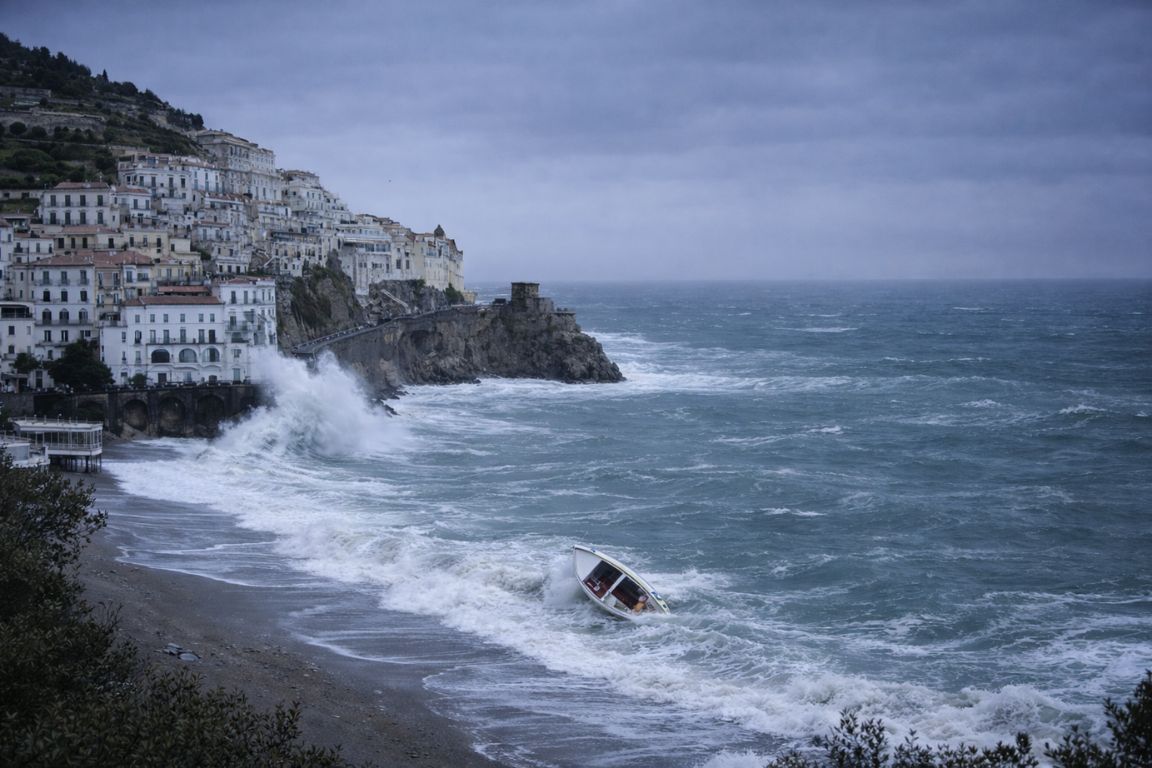
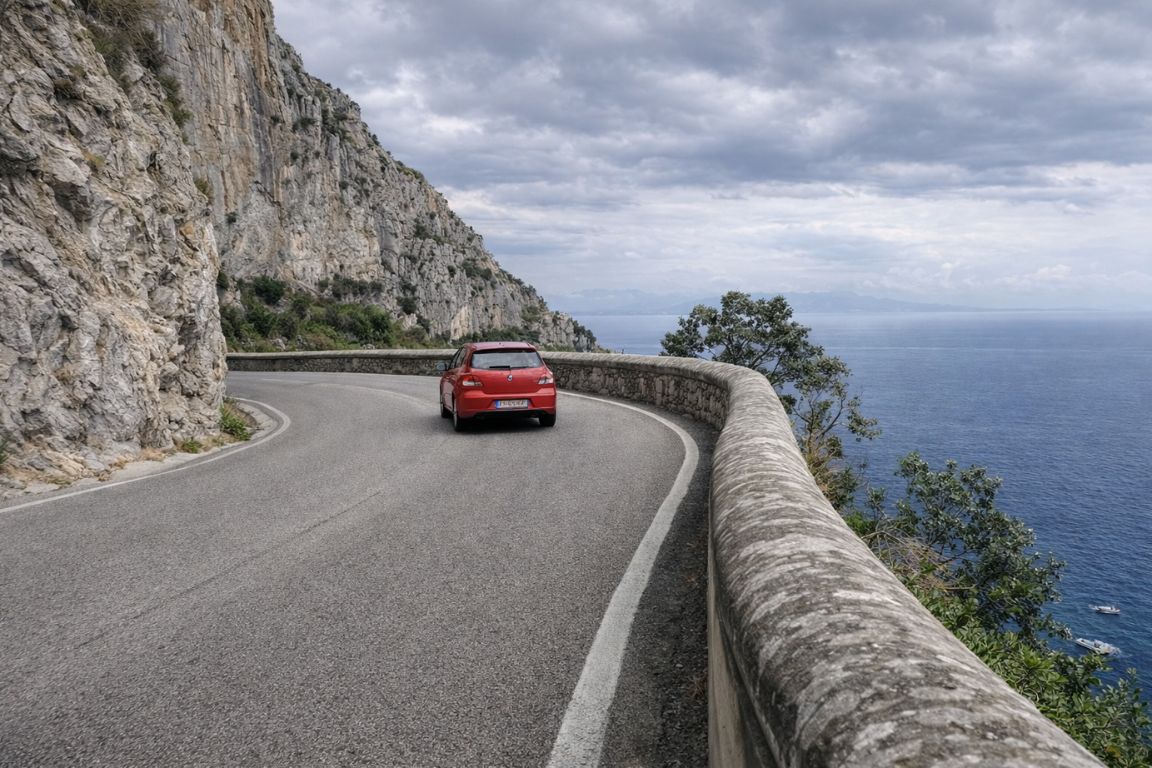
This is the single most useful thing to know about swimming here. The coast road, the SS163, runs high along the cliff face, and the sea is often 100 metres below it with nothing but rock in between. Where a stairway was never cut, the cove stayed accessible only from the water, and those are consistently the quietest and clearest places to swim on the entire coast. Santa Croce is stones and pebbles with a bar and restaurant, run as a mix of equipped and free space. Cauco, tucked between two Saracen watchtowers at Erchie, is about 150 metres of shoreline that no road touches.
You have two ways in. Local taxi boats operate on demand from Amalfi's port and from Positano's harbour, dropping you at a cove in the morning and collecting you later. Or you join a small boat that spends the day working along the cliffs and stops to swim, which is the option most visitors end up preferring because it reaches the coves nobody can walk to and covers the sea caves in the same run. The small-group Gozzo trip out of Positano and Amalfi swims at hidden inlets such as La Porta and the Fiordo di Furore and puts in at grottoes including Saint Andrew's Cave and the Africana, none of which have a land approach.
Timing matters more for boat-only coves than for anything else in this guide, because a swell that barely registers on the coast road will keep a tender in port. Our note on which month suits a boat day best sets out how the sea behaves across the season, and if you are working out how to move between towns in the first place, getting around the coast without a car covers the ferries and the SITA bus.
How Many Steps Stand Between The Road And The Water?
Anything from none to about 400. Spiaggia Grande, Marina di Praia, Atrani and Maiori are effectively step-free. Castiglione below Ravello and Marina di Albori at Vietri are around 200 steps. Arienzo and Marina di Conca are around 300. Duoglio, near Amalfi, is about 400, and you climb all of them again at the end of the day.
Step counts sound like trivia until you are carrying a cool bag up them at four in the afternoon in 32-degree heat. They are also the single best predictor of how busy a beach will be. The correlation across the coast is almost perfect: the more steps, the fewer people, the clearer the water, and the more likely you are to have a stretch of shingle to yourself.
Duoglio is the honest test case. It is a genuinely lovely cove of sand and pebbles with both free and equipped sections, and it sits at the bottom of roughly 400 steps cut down from the SS163 west of Amalfi. Plenty of people do it once, enjoy it, and take the taxi boat back. That is the sensible move, and the boatmen at Amalfi's port run the service precisely because so many visitors make the same calculation.
Marina di Conca, below Conca dei Marini, is around 300 steps and rewards them with restaurants and full facilities at the bottom. Castiglione, the beach that serves Ravello, is about 200 steps below the road and keeps a free stretch of roughly 100 metres alongside its clubs, which makes it the most realistic swim for anyone staying up in Ravello without a car.
Use the access column to avoid a descent you cannot comfortably reverse. Boat boarding has its own requirements and is not automatically step-free. Compare beach access
Where Should Families And Weaker Swimmers Go?
The eastern end of the coast. Maiori has nearly a kilometre of gently shelving dark sand with free sections at both ends, Minori is a shorter version of the same thing, and Atrani puts a small sandy beach at the foot of a village square. All three are step-free, all three have shallow entries, and none require a boat.
Maiori is the outlier on this coast and the reason it exists as a family destination at all. Its beach is the longest anywhere along the Amalfitana, roughly 900 metres to a kilometre of dark volcanic sand, crossed at its midpoint by the mouth of the Rheginna stream, which usually runs dry through the summer. Most of the frontage is licensed to clubs, but both ends stay free, and the promenade behind it means you can reach food, shade and a pharmacy without climbing anything.
Minori is the quieter neighbour: medium-grain sand, about 250 metres long, separated from the town only by the road. Atrani deserves a mention out of proportion to its size. It is the smallest comune in Italy by area, 12 hectares, with a population of 764 as of 2025, and its beach sits directly below the piazza where village life happens. There is an equipped section and a free one, and the whole place is a five-minute walk from Amalfi through a tunnel most day-trippers never notice.
| Beach | Steps | Entry into the water | Free section | Best for |
|---|---|---|---|---|
| Maiori | None | Gently shelving sand | Both ends | Small children, long days |
| Minori | None | Shallow sand | Yes | Quieter family swim |
| Atrani | None | Sand, sheltered | Yes | A base within walking distance of Amalfi |
| Marina di Vietri | Steep descent from town | Wide sand | Yes, split by the river | Space, at the Salerno end |
| Marina di Praia | None | Deep water quickly | Small free area | Confident swimmers only |
The counterpoint matters too. Marina di Praia is one of the most photogenic inlets on the coast and the water goes deep fast, which is glorious if you swim well and unnerving if you are supervising a six-year-old. The Fiordo di Furore is the same story in miniature: about 25 metres of free shingle under a viaduct, spectacular, and not a paddling beach.
Keep a shore beach with suitable facilities as the first option for a family swim. Confirm local conditions and supervision on the day. Choose a shore-based beach
Which Beaches Keep The Sun Longest Into The Afternoon?
Arienzo in Positano and Gavitella at Praiano are the two the locals name, because both face southwest and stay lit while the rest of the coast falls into cliff shadow. Most Amalfi Coast beaches lose direct sun somewhere between three and five in the afternoon, far earlier than the latitude suggests.
The whole coast faces roughly south, but it faces south from the bottom of a wall. As the sun swings west the ridge behind each town cuts the light off long before sunset, and a beach that was baking at noon goes cool and grey within twenty minutes. It is the most common surprise for first-time visitors, and it is why afternoon-facing coves carry a genuine premium.
Arienzo is the clearest case in Positano: it sits on the eastern side of the bay, angled southwest, and holds the light later than Spiaggia Grande, Fornillo or Laurito. Praiano built its reputation on the same geometry, which is why the town is known for its sunsets while Positano, two headlands west, watches the light leave early. If your priority is a long lazy afternoon in the sun rather than a swim before lunch, that single fact should decide where you go.
If afternoon light is the priority, choose the beach orientation before booking a lounger or committing to transport. Compare Positano’s beach settings
Where Do People Go To Get Away From The Crowds?
East of Amalfi and off the tour-bus route. Cetara is a working anchovy port with a small beach and almost no day-trippers, Erchie hides two coves behind Saracen towers, and Vietri sul Mare has the widest sand on the coast because nobody thinks of it as a beach town. West of Amalfi, quiet means boat-only.
Cetara's Marina beach is about 90 metres of sand and pebbles beside the port, with free and equipped sections, and a second cove at Lannio reached by steps near the old viceregal tower. The town still lands and salts anchovies commercially, which gives it an atmosphere the resort villages lost decades ago and makes it the best lunch stop on this half of the coast.
Erchie, technically a hamlet of Maiori, has around 200 metres of fine sand with a pebbly waterline, plus the Cauco cove next door that only a boat reaches. Beyond it, Suverano is white pebbles down a difficult cliff path, completely free, with no services of any kind, which is either the best beach on the coast or a serious mistake depending on what you brought with you. Vietri sul Mare, the ceramics town at the Salerno end, has an unusually wide sand beach split by a river mouth and a second one at La Baia running about 400 metres.
| Beach | Town | Why it stays quiet | Services |
|---|---|---|---|
| Marina beach | Cetara | Off the standard day-trip loop | Free and equipped, port restaurants |
| Erchie | Maiori | Awkward to reach without a car | Free and equipped |
| Cauco | Erchie | Sea access only | None |
| Suverano | Maiori | Difficult cliff path | None at all |
| La Baia | Vietri sul Mare | Seen as a Salerno beach, not a coast beach | Several establishments |
| Santa Croce | Amalfi | Boat only | Bar and restaurant |
Pair an eastern beach with a town lunch for an independent day beyond the best-known western stops. Plan the eastern towns
What Should You Pack For A Pebble Beach?
Water shoes first, then a thin foam mat or a proper beach mattress rather than a towel, then more water than you think. Stones get painfully hot by midday, a towel over shingle is uncomfortable within an hour, and the free sections rarely have shade, showers or a bar.
The gear list looks fussy written down and makes a real difference in practice. Rubber-soled water shoes let you walk into the sea without the wincing shuffle that defines a first day here, and they matter more at the coves where the waterline is coarse stone. A foam mat spreads the load over pebbles in a way fabric cannot. If you are heading to a free section rather than a club, assume no umbrella rental, no lounger, no fresh-water shower and no toilet.
| Item | Why it earns its place | Skip it if |
|---|---|---|
| Water shoes | Hot stones, sharp waterline, sea-urchin rocks | You are only on sand at Maiori or Minori |
| Foam mat or inflatable mattress | A towel over shingle stops being comfortable fast | You booked a club lounger |
| Dry bag | Taxi boats and Gozzo tenders take spray | You are walking in and staying put |
| Two litres of water per person | Free sections have no bar, and the climb back up is the hard part | You are at a club with service |
| Cash | Taxi boats and small kiosks are still cash-first | You are at a large establishment |
| Mask and snorkel | Clear water over rock beats clear water over sand | Your boat trip supplies gear, as most do |
How Do The Beaches Compare Side By Side?
Read this table left to right and the coast sorts itself into three groups: step-free sandy beaches at the eastern end, cliff-stair coves in the middle, and boat-only inlets west of Amalfi. Pick your group first, then the individual beach.
| Beach | Town | Access | Surface | Free area | Best for |
|---|---|---|---|---|---|
| Spiaggia Grande | Positano | Walk from town | Dark sand and pebbles | Yes, at the edges | The view, boats, people-watching |
| Fornillo | Positano | 10 min cliff path | Gravel and pebbles | Yes | Same water, calmer |
| Arienzo | Positano | About 300 steps or boat | Sand, gravel, pebbles | Yes | Afternoon sun |
| Laurito | Positano | Stairway or boat shuttle | Sand and pebbles | Yes | Lunch on the water |
| Marina di Praia | Praiano | Step-free from the road | Sand with pebbles | Small | Drama, deep water |
| Fiordo di Furore | Furore | Stair access below the bridge; confirm current access locally | Sand and pebbles | Entirely free | Photographs, a quick swim |
| Marina di Conca | Conca dei Marini | About 300 steps | Pebbles and gravel | Limited | Facilities, clear water |
| Duoglio | Amalfi | About 400 steps or taxi boat | Sand and pebbles | Yes | Escaping Amalfi town |
| Santa Croce | Amalfi | Taxi boat only | Stones and pebbles | Yes | Quiet water and a long lunch |
| Atrani | Atrani | Step-free | Medium-grain sand | Yes | Village life, families |
| Minori | Minori | Step-free | Medium-grain sand | Yes | Uncomplicated family days |
| Maiori | Maiori | Step-free | Dark volcanic sand | Both ends | Space, shallow water |
| Erchie | Maiori | Step-free, awkward to reach | Fine sand, pebbly edge | Yes | Getting away from it |
| Cetara | Cetara | Step-free from the port | Sand and pebbles | Yes | A real working town |
| Marina di Vietri | Vietri sul Mare | Steep walk down | Wide sand | Yes | Room to spread out |
So Which Beach Should You Pick?
If you have one afternoon and you are staying in Positano, walk to Fornillo rather than fighting for space on the main beach. If you are travelling with young children, base the beach day at Maiori or Minori and accept the drive. If you want to see the cliffs and spend time on the water, compare a boat outing with your shore-based beach day. Swim stops depend on the itinerary and conditions, and a boat does not guarantee an empty cove. That is the logic behind every itinerary listed on Italy Amalfi Coast Tours, and it is why a day on the water usually beats a day on a lounger here.
Three practical closing points. Go early or go late, because the middle of the day in August is the worst of both the crowds and the heat. Read up on how rough the sea gets here before committing to a boat-only cove, since the same swell that makes ferries wobble will keep a taxi boat in port. And if you are choosing between a lounger and a boat trip on the same budget, the boat wins on this particular coastline, where the shoreline is vertical and the interesting water starts a few hundred metres out. Once you are afloat, the natural next stop is Capri, and the honest question there is whether the Blue Grotto deserves the queue.
Choose your coast-cruise date before fitting in a separate Ravello visit. See the cliffs from the water and take swimming breaks, with snorkeling gear and drinks included. Choose Your Coast-Cruise Date
Frequently Asked Questions
Are Amalfi Coast beaches sandy?
Mostly not. The great majority are pebble, shingle or coarse dark grit, because the mountains meet the sea too steeply for sand to accumulate. Genuine sand is concentrated at the eastern end of the coast, at Maiori, Minori, Atrani and Vietri sul Mare. Maiori has the longest beach on the coast at roughly 900 metres to a kilometre of dark volcanic sand.
Which Amalfi Coast beach is free?
Almost every major beach keeps a free public section, usually at one or both ends, alongside the licensed clubs in the middle. The Fiordo di Furore is free in its entirety, as are the wilder coves such as Suverano at Maiori. Free sections generally have no umbrella rental, no showers and no bar, so bring water and shade.
Which Amalfi Coast beaches can only be reached by boat?
Santa Croce near Amalfi and the Cauco cove at Erchie have no stairway and are reached only from the sea. Taxi boats run to them on demand from Amalfi's port, and small-group boat trips along the coast stop at several inlets and sea caves that no road or footpath touches.
Which Amalfi Coast beaches have a Blue Flag?
For 2026 the only Amalfi Coast comune on the list is Positano, awarded for Spiaggia Grande, Fornillo, Arienzo and Laurito. Across the water Anacapri holds one for Gradola, next to the Blue Grotto, and the Sorrentine Peninsula towns of Sorrento, Massa Lubrense, Vico Equense and Piano di Sorrento are also on the list. The award goes to the comune's services and water sampling together, so a missing flag often means a town did not apply rather than that its water is poor.
Which Positano beach gets the most afternoon sun?
Arienzo, known locally as the 300 steps beach. It faces southwest and holds direct sun later than Spiaggia Grande, Fornillo or Laurito, which fall into cliff shadow earlier. Praiano's Gavitella works on the same geometry, which is why that town is known for its sunsets.
What would you add to your independent day? Discover coast cruise and capri boat day, with departure points and the time each experience takes laid out below. Discover Coast Cruise & Alternatives